
Mostly at the very top. Semrush found position-one pages were 80.5% likely to be human-written versus about 10% for AI-generated, while Ahrefs found 5.3% of top-3 pages are 100% AI-generated. Different detectors, same direction: Google isn't banning AI content, but originality wins the top spots more often than not.
How this was made: a self-initiated writing sample, researched from the primary sources listed in Sources and method. I use AI where it helps with research and workflow; the argument, structure and final wording are mine.
Sixty-three. That's how many AI-assisted posts I shipped in 2025, or thereabouts, I stopped counting properly somewhere past fifty and just trusted the spreadsheet. I tracked everything. Headline targets, hit. Keywords, hit. Every box on every checklist, hit.
And then engagement dropped 34% anyway, which is the kind of number that ruins a Tuesday. Unsubscribes tripled. Three clients I'd worked with for years just stopped replying. No drama. Just silence.
The posts weren't wrong, that's the part that still bugs me. They were correct, on-brief, technically fine, and forgettable the way a hotel room is fine. That was the year I figured out the actual gap between content and creativity. Agentic AI can fake one of those. Not both.
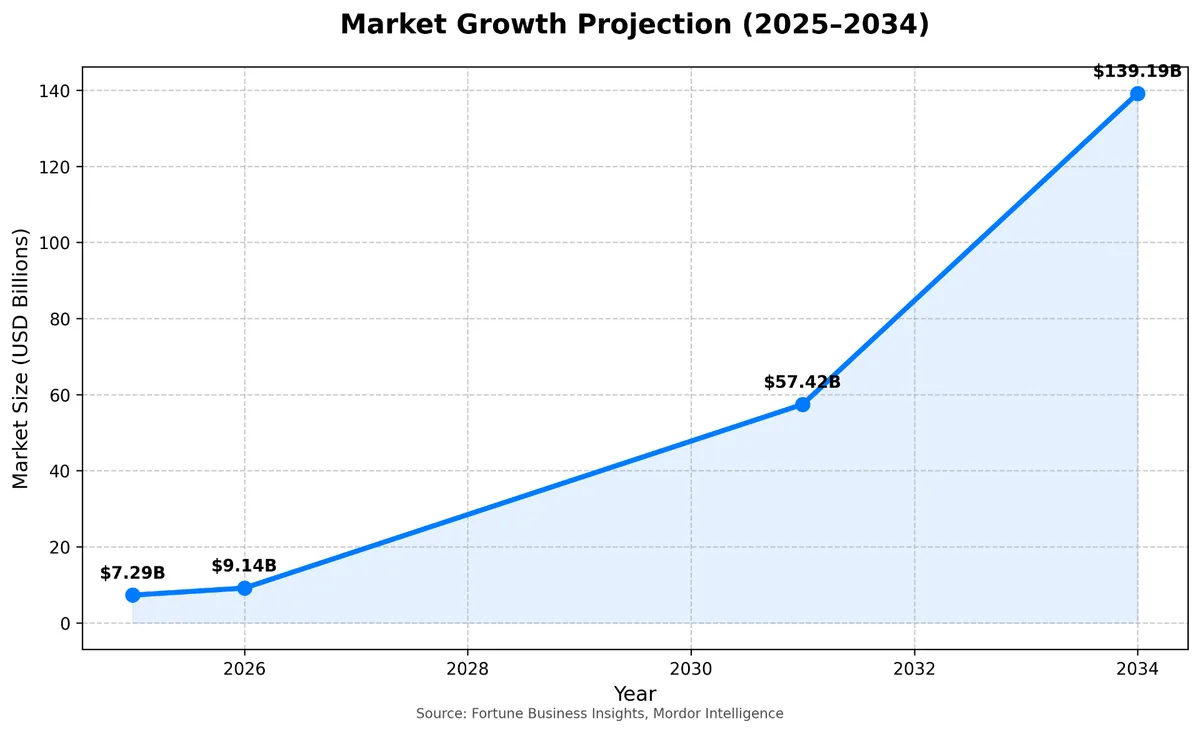
Here's what was happening at the same time, on a much bigger scale than my little spreadsheet. Agentic AI flooded every content vertical at once. Tools that research, draft, and publish across text, images, video, and music (with barely a human touching any of it) became standard enterprise plumbing. PwC's May 2025 survey put it at 79% of executives already running AI agents, which, fine, I can't independently verify a PwC number any more than the next person, but it tracks with everything I was seeing client-side. The global agentic AI market hit somewhere around USD 7.29 billion that year. Machine-generated content didn't trickle onto the internet. It poured.
Audiences noticed. Engagement dropped, not just mine, everyone's, eventually. Brands lost trust faster than anyone budgeted for. Clients stopped asking "can you produce this faster?" They started asking, almost sheepishly, "does this sound like a person?"
The market corrected itself, the way markets do, badly and late. The slop era arrived in full. And somewhere in that mess sat the most useful insight in content creation since the algorithm took over: the creators doing well in 2026 didn't out-automate everyone. They figured out something almost embarrassingly simple: in a world of infinite AI content, human creativity is the actual product.
So What Is "AI Slop," Actually?
Before the data (and there's a lot of it coming), let's nail down what we're even arguing about. Everyone throws "AI slop" around like it's self-explanatory. It isn't, not really. And if you can't define it, you can't tell whether you're making it.
AI slop is content built (by a machine, or by a human leaning hard on one) to look high-quality without doing the work quality actually requires. It hits every keyword. Passes every readability checker you run it through. Hook, subheadings, conclusion, call to action: all present, all accounted for. And it says nothing that could only have come from one specific person looking at the world from one specific angle. That's the tell.
"Slop" picked up Word of the Year honors in 2025, which tells you something about where things had gotten to. It describes writing built to waste your time more efficiently than anything before it.
AI slop is not the opposite of good writing. It is the opposite of real writing.
– Definition, Content Strategy 2026
Walk through any feed in 2026 and you'll trip over it constantly. Which is, weirdly, good news for the rest of us. Scarcity does that.
What Agentic AI Did to the Internet
Forget the future-threat framing. Agentic AI isn't coming: it's already humming away inside most enterprise content pipelines, has been for a while. The interesting question was never whether it would arrive. It's what it actually made once it got here.
From Copilot to Autonomous Producer: What It Can Do Right Now
These systems don't sit around waiting for a prompt. They read the brief themselves, generate the assets, test a few variants, and push the winner through the publishing pipeline, often without a human touching any of it. Jasper's AI Agent and Copy.ai's Workflows research a topic, draft the post, adjust for brand voice, and schedule it. Nobody in the loop. Not a hypothetical setup: a Tuesday, for a lot of marketing teams.
On the design side, Firefly takes a brief and spits out finished, on-brand assets. Amazon's Creative Agent goes further still: scripts, imagery, animation, voiceover, music, the whole video ad, soup to nuts. This isn't a demo running on a conference stage somewhere. It's live.
Gartner's number, for what it's worth: 40% of enterprise applications carrying task-specific AI agents by the end of 2026, up from under 5% the year before. I can't independently verify a Gartner forecast (nobody outside Gartner really can), but it lines up with what every creator I talk to keeps describing. That's the scale that built the slop conditions everyone's wading through right now.
Agentic AI vs. Human Creativity: 2026
Tables feel a little clinical for a topic this messy, but sometimes you just need to see it laid out flat. Here's where each side actually wins. No spin, no rounding the corners.
| Dimension | Agentic AI | Human Creator | Current Winner |
|---|---|---|---|
| Volume & Speed | Unlimited output, 24/7, millisecond generation | Constrained by time, energy, and cognitive load | AI |
| Idea Originality | Fixation bias; converges on averages; 37/45 comparisons showed less diversity (Wharton, 2025) | Divergent thinking, subconscious links, genuine breakthrough ideas | Human ✓ |
| Emotional Resonance | Copies emotional style; has no genuine emotional substrate | Creates from real joy, grief, love, shame: gives work interpersonal force | Human ✓ |
| Cultural Nuance | Trained on Western-dominant data; flattens local norms and context | Understands local references, history, and audience-specific meaning | Human ✓ |
| SEO & Keywords | Near-perfect keyword density, heading structure, metadata | Requires deliberate effort and tooling to match AI output | AI |
| Legal Ownership | Fully AI-generated work is not copyrightable (U.S. Copyright Office, 2025) | Full copyright; enforceable and commercializable | Human ✓ |
| Accountability | Cannot be held responsible for errors, brand damage, or ethical violations | Legally and professionally accountable for every output | Human ✓ |
| Idea Diversity at Scale | Reduces diversity; 37 of 45 comparisons showed less variety with AI use | Maintains diverse output when free from AI suggestion loops | Human ✓ |
Stare at that for more than ten seconds and a pattern jumps out: AI wins on whatever's cheap to automate. Humans win on whatever's expensive to fake.
The Slop Epidemic: What Happens When Content Costs Nothing
When content costs nothing to make (and everyone figures that out around the same time), the internet doesn't get better. It gets loud. Then louder. Until you can't find the signal in the noise anymore, and honestly, some days I'm not sure I can either.
Slop Fatigue Is Real and Measurable
This isn't a vibe I'm extrapolating from three conversations at a conference bar. Scroll through r/DigitalMarketing, r/copywriting, r/UXDesign: same story, over and over. People aren't creating anymore. They're bailing water out of a boat made of "workslop," which is apparently the term now: babysitting an agent that produces confident, fluent nonsense, and calling the cleanup a job.
Sendtric tagged Gen Z "Generation Skeptic" in 2026, not my favorite bit of branding, but the underlying point holds up. They clock AI content fast. Faster than I can, honestly, and I do this for a living. Then they disengage on instinct, no debate involved. Human-led content beats synthetic media in paid social metrics, not because anyone's consciously choosing it, but because it clears a bar no algorithm has figured out how to fake yet: it feels real.
From Artist to AI Janitor: The Creator's Experience
Block cut 40% of its staff, more than 4,000 jobs. Pinterest cut roughly 15% of its workforce to redirect spending toward AI. Amazon eliminated about 14,000 corporate roles in one round alone, with later reporting putting the running total closer to 30,000. The pattern got a name in 2026: the "AI-hopeful layoff." Companies framed several of these cuts as AI-driven, though pinning any one layoff on AI is hard to verify. The one person left standing gets handed a workflow and a quiet expectation: do what five people used to do. Nobody says that part out loud in the memo, obviously.
"They think one person can do it all? Then they can go right on ahead and do it all themselves. Until then, I shall continue to become one with nature in my back yard and pretend I don't live in this timeline."
– Burned-out designer, after department-wide layoffs
"Slop" picked up Word of the Year honors in 2025, which tells you something about where things had gotten to. Creators reach for it to describe content that's technically flawless and says almost nothing: keyword-rich, structurally sound, and hollow at the center.
The Audience Verdict: Human Creativity Is Beating Agentic AI
Attention's always been the only currency that mattered online, and right now audiences are spending theirs deliberately against slop. The data backs it up. Mostly.
Gen Z's Slop Detectors and the Authenticity Instinct
Gen Z grew up with both kinds of content hitting their feed at once, human and machine-made, no label on either. That makes them the first generation that can tell the difference by feel alone: the way you can tell margarine from butter without checking the wrapper, if you grew up eating both. Sendtric calls them "Generation Skeptic." Not anti-tech. Just allergic to the texture: the transitions that are a little too smooth, the voice that isn't quite anybody's, the piece that covers six angles and somehow says nothing.
No outrage involved. Just instinct: scroll, close the tab, skip the follow. Done.
Platform Algorithm Dynamics: Google, YouTube, and TikTok Are Responding
None of these platforms are neutral referees, whatever the press release says. Google's Helpful Content system rewards people who've actually done the thing they're writing about, and quietly buries pages built to please the algorithm instead of the reader. YouTube leaned into watch time and return viewership, which favors creators people come back for over farms chasing a first click they'll never see again. TikTok's whole engine runs on faces, voices, the specific weirdness of an actual personality: polished and anonymous just doesn't move the same way there.
Every one of these platforms tilts toward human creativity for the same boring, commercial reason: it keeps people scrolling longer. So it's not quite that audiences "prefer" human content, like it's a flavor of ice cream. The plumbing of the internet got rebuilt to push it to the top. That's a different kind of advantage entirely.
What the Ranking Data Actually Shows: Semrush, Ahrefs, and Sprout Social
Two large 2026 studies tested the same question from different angles, and a consumer survey tested the audience side. Read side by side, they agree on the direction and disagree on the size, mostly because they measure different things.
| Study | What it measured | Result | The catch |
|---|---|---|---|
| Semrush, April 2026 | 42,000 blog pages across 20,000 keywords, labeled human, AI or mixed by GPTZero | Position 1: 80.5% probability human-written vs 10% AI-generated | Labels come from a detector, blog URLs only, and Semrush sells content tools. |
| Ahrefs, July 2026 | About 150,000 top-10 pages (from 100,000 SERPs) with enough text to test | 5.3% of top-3 pages were 100% AI; 54.7% had under 20% AI. Low and moderate AI pages earned 2-3x the impressions of high and very-high AI pages | Uses Ahrefs' own detector (pages of 350+ words). Ahrefs says it differs from whatever Google does, and the data shows correlation, not cause. |
| Sprout Social, Q1 2026 | Consumer survey run by Glimpse, fielded Feb 5-9, 2026 | 56% see AI slop often; 50% of Gen Z have blocked, muted or unfollowed a brand or creator over it. The top thing consumers want brands to stop is posting unlabeled AI content | Self-reported, and commissioned by a vendor. It points at labeling and quality, not at AI itself. |
Why they look different: Semrush asks who is most likely to hold position one. Ahrefs asks how much AI text shows up across the whole top 10 and the index. Fully AI pages do rank, but they are rarer at the top and earn fewer impressions. Ahrefs' own reading is that Google punishes bad content rather than AI, and that the two overlap because most AI content is thin. Google's guidance says the same thing from the other side: it rewards original, helpful content and treats AI used mainly to manipulate rankings as spam.
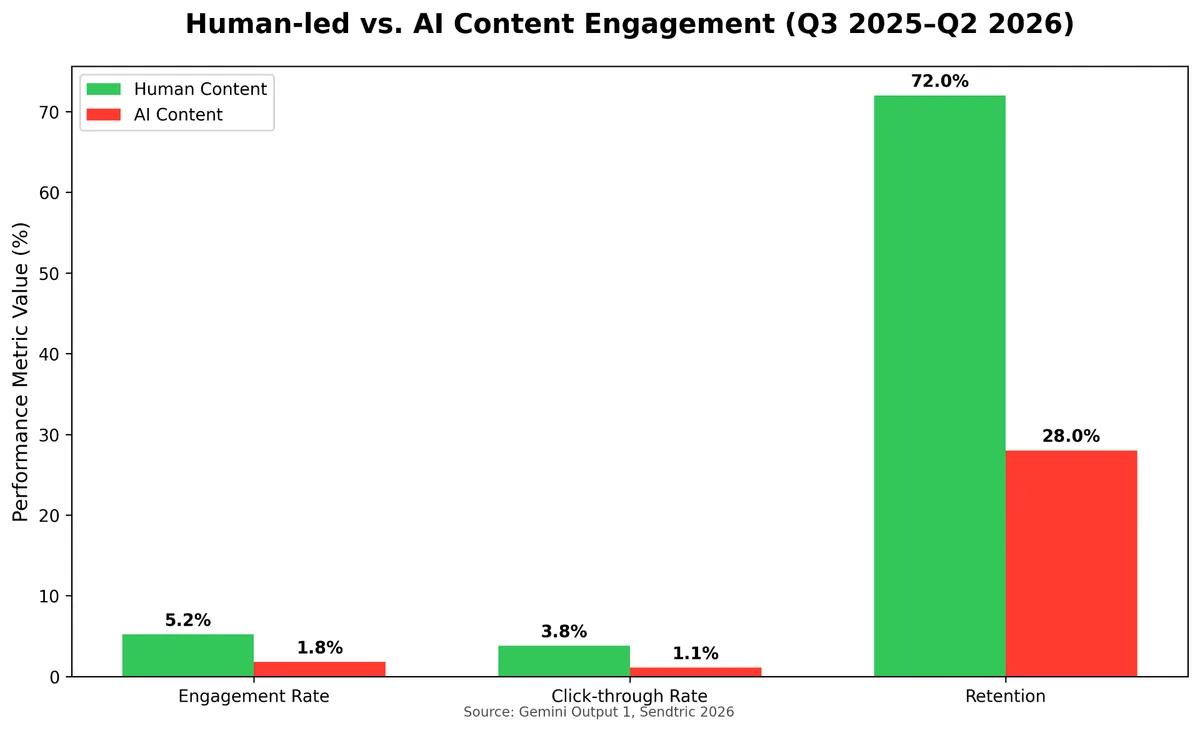
AI detectors are probabilistic and none of these studies shows Google detects or demotes AI as such. The engagement chart earlier in this article comes from the author's own campaigns, so it is not independent evidence. Treat the pattern as directional: originality and real expertise correlate with the top spots, and audiences say they want honesty about how content was made. For how I check claims against primary sources, see the Visa agentic-commerce dispute breakdown.
What the Research Says: Human Creativity Has Advantages AI Cannot Engineer
Forget the op-eds for a second: everyone's got a take, mine included. Here's what the actual research from 2025 and 2026 says (mostly peer-reviewed; the April 2026 ArXiv paper below is still a preprint), and it's more one-sided than the public argument lets on.
A 2025 Wharton study found ChatGPT actually improved individual idea quality. Good news, on paper. Then the catch: it cut group idea diversity. Thirty-seven out of forty-five comparisons, groups leaning on ChatGPT ended up with less varied ideas, not more.
At scale, that's the trade you're actually making: not more ideas. Just shinier copies of the one idea everybody already had.
A separate 2025 study in Frontiers in Psychology backed it up, though not quite the way I first read it: when researchers ran ChatGPT-4o through a classic fixation-bias task, it matched humans' pull toward conventional answers — and showed a limited ability to tell an original idea from a derivative one, a distinction the human participants in the same study could actually make.
Tilburg's meta-analysis is the closest thing to a final word on it, at least for now: pooling 17 studies and 115 effect sizes, it found no reliable evidence that AI has surpassed humans at creative idea generation. A handful of individual studies did show AI pulling ahead, but those effects didn't hold up once researchers checked for outliers. The paper's own title hedges it precisely: generative AI "has not (yet?) surpassed" human creativity. That question mark is doing real work, and I'd rather leave it in than pretend it isn't there.
Sources: Knowledge@Wharton 2025 · Frontiers in Psychology 2025 · Tilburg University 2025An ArXiv paper from April 2026 ("On the Creativity of AI Agents", ArXiv:2604.13242) draws a distinction most of the mainstream debate keeps stepping over.
Functionalist Creativity is about output quality. Ontological Creativity is about what happens to the creator during the act of making.
AI nails the functional kind. It just can't be changed by anything it makes: there's no "after" for a model. Write a brutal essay about grief as a human, though, and you come out the other side a slightly different person than you went in. It rearranges something. AI doesn't have that problem, or that gift, depending on how you want to look at it. Tokens in, tokens out. Same model on the other end either way.
That is not a technical gap. It is a categorical one.
Source: ArXiv:2604.13242 · April 2026A 2025 study called TaarofBench ran five frontier LLMs — including models from OpenAI, Anthropic, and Meta — through Persian cultural etiquette scenarios: the kind of social nuance that doesn't show up in a training manual. Native speakers handled them right 81.8% of the time (the human baseline was 11 native speakers). The five frontier models tested landed 40–48% below native speakers when taarof was culturally appropriate, per the EMNLP 2025 paper.
UNESCO flagged the same problem in their 2025 culture report: train a model on lopsided data and it doesn't just miss nuance, it actively flattens it, reinforces whatever bias was already baked in. Simulating a culture and understanding one aren't the same move. People from inside that culture tend to clock the difference almost instantly.
Sources: TaarofBench study 2025 · UNESCO 2025AI can generate creative outputs, but humans still anchor creative significance.
– Synthesis from Wharton, Tilburg University, and Nature research, 2025
The Authenticity Premium: Why Being Provably Human Is a Business Strategy
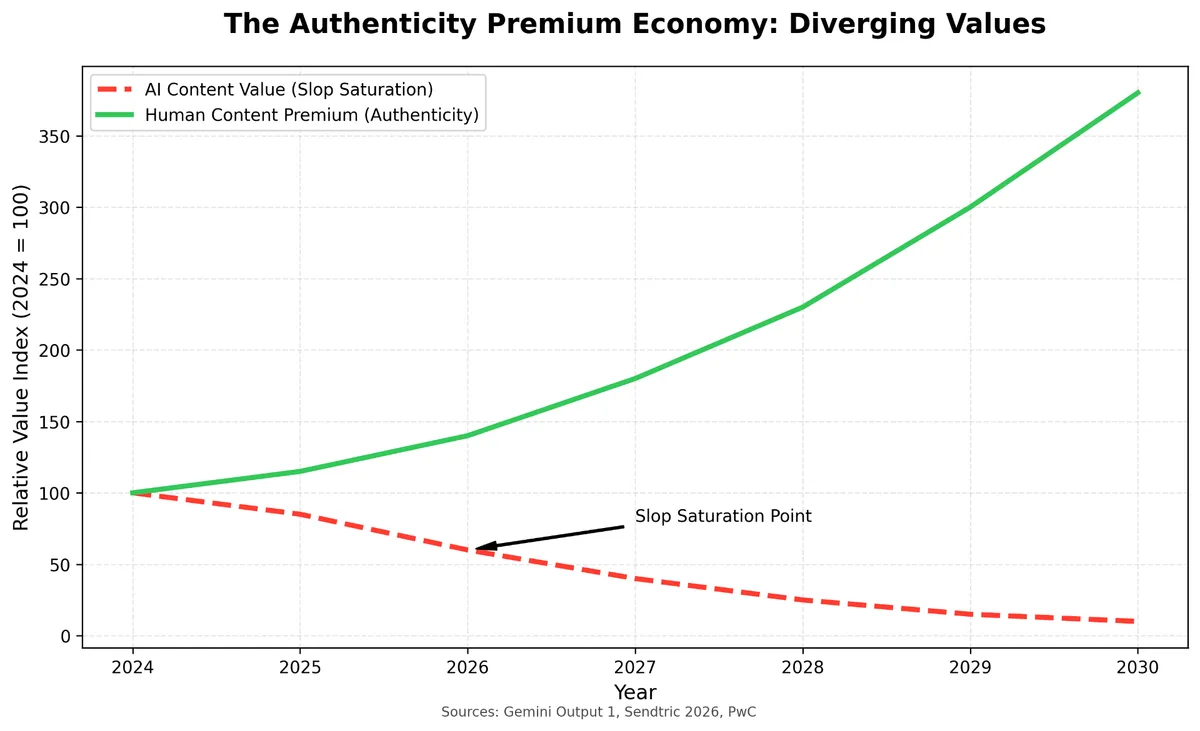
Here's the part that should make you a little less anxious, or at least redirect the anxiety somewhere useful. Agentic AI flooded everything with slop. Audiences got good at smelling it. And now, provably being a human who made the thing is an actual competitive edge, not a nice-to-have, a structural one. The sharper creators are already charging for it.
The Liability Layer: Human Sign-Off Is Now a Legal Instrument
The U.S. Copyright Office addressed this directly in 2025: fully AI-generated work with no human authorship isn't copyrightable. Companies can generate endless content. They just can't own any of it: can't sue a competitor for ripping it off, can't really commercialize it cleanly without a human going through, revising it, attaching their judgment to it.
In healthcare, legal, enterprise marketing (anywhere a mistake actually costs something), that turned human oversight into a real line item. The sign-off used to just mean "someone proofread this." Now it's closer to a notarized signature. And signatures like that don't come cheap.
The Proof of Struggle Economy
Here's a distinction I keep coming back to: human-made stuff runs in two directions. It changes the world a little, sure, but it also changes the person making it. AI only runs one direction. It adds output to the pile. That's the whole transaction.
Once content is basically free to produce, visible effort becomes the rare thing. Creators showing their research, posting the draft that didn't work, letting people see the messy middle: that's not just vulnerability marketing, or not only that. It's a moat. No agent can fake a paper trail of someone actually struggling through a problem. The product, increasingly, isn't the finished post. It's the receipt that a person sweated over it.
What Brands Pay for in 2026
Brands that got burned by a hollow AI campaign (and there are plenty now) started budgeting for human oversight, cultural review, actual voice development. Nobody asks "can you do this cheaper?" anymore. They ask "can you guarantee this is actually yours?" Different conversation entirely.
And the logic runs backwards from what you'd expect. Nobody's paying extra because human content reliably beats AI on click-through or keyword rank: honestly, AI copy wins those metrics constantly, no contest. They're paying because human authorship carries something AI can't: legal weight, cultural accountability, and the possibility, the actual possibility, of being wrong in a way that means something.
A machine cannot be embarrassed by its output. That limitation is not a bug to be engineered away. It is the structural reason authenticity commands a price at all.
Which Jobs Will Survive, And What the Winning Creator Looks Like
Stop asking "will AI replace me?" It is the wrong question. It produces the wrong answer. The right question is simpler: which part of what I do requires a human, specifically me?
The Roles Most Exposed
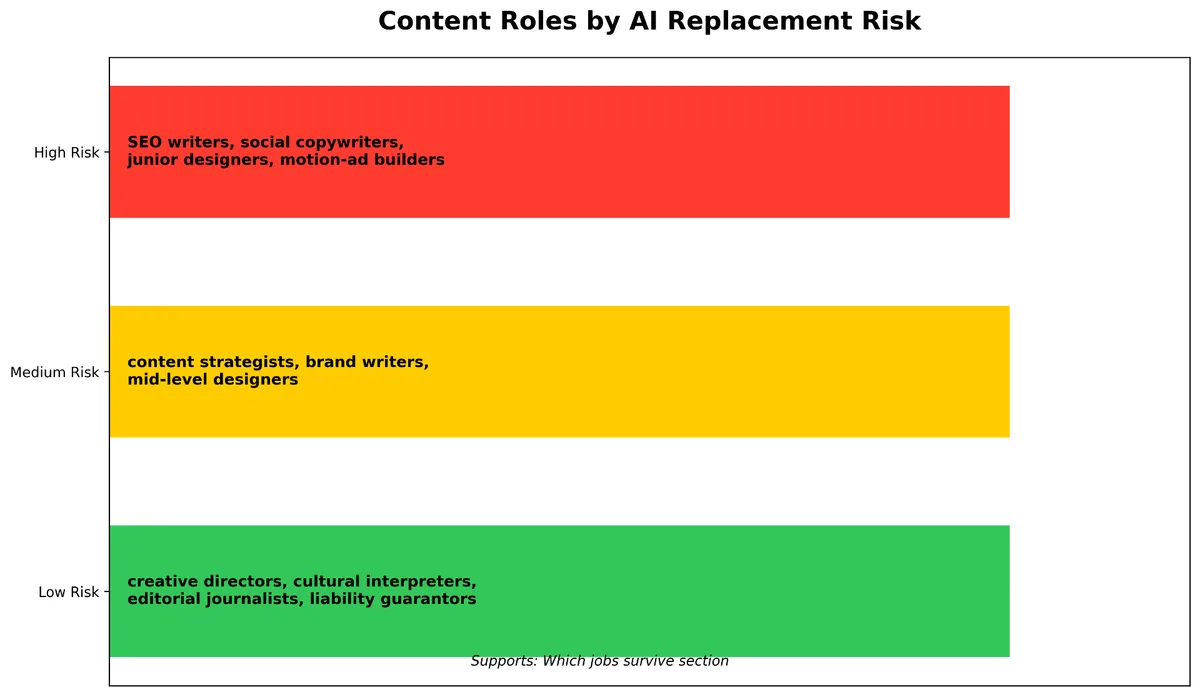
The research doesn't soften this. Most exposed: SEO writers cranking out high-volume keyword content. Social copywriters churning post variants. Junior designers resizing the same asset for the eleventh platform. Motion-ad assemblers, stock-music producers. The common thread isn't the job title: it's that the work is high-volume, standardized, and already living inside a software pipeline somewhere. If a process can be drawn as a flowchart, it's probably half-automated already.
The New Creative Profile: Orchestrator, Taste-Setter, Liability Guarantor
The creators doing well in 2026 know the whole agentic pipeline cold: where it works, where it quietly breaks, where it opens up legal exposure nobody noticed yet. They've made themselves the one human stamp that makes the rest of the system trustworthy enough to ship.
The creative skill commanding the highest rate in 2026 is not generating content. It is guaranteeing it.
Three things show up consistently across Tilburg, Wharton, and Nature as AI-resistant: cultural nuance, emotional resonance, and original point of view. Not safe because AI can't approximate them: it can, sort of, on a good day. Safe because they require a specific person who actually lived through something, and can be held responsible when the judgment turns out wrong.
Frequently Asked Questions
Can AI replace creativity?
Is AI good or bad for creativity?
Why are people against AI-generated content?
Will 90% of content be AI-generated?
The internet's always been a mirror, one way or another. The dot-com era believed in pure information. Social media believed in pure connection. This era believes in pure production: make more, faster, cheaper, call it progress. Mirrors don't make culture, though. People do. They just keep forgetting that part.
What the slop fatigue data actually shows, if you squint at it long enough: nobody ever wanted more content. They wanted something that came from somewhere real. From a person who thought hard about it, got some of it wrong, and then picked the words they actually meant instead of the ones that tested well.
Agentic AI made content infinite. That, almost by accident, made human creativity scarce again, properly scarce, for the first time in a decade. Scarcity is where value has always lived, whether anyone planned it that way or not. The platforms figured it out. The data backs it up. Audiences know it too, on some level, even the ones who couldn't tell you why they kept scrolling on one video and not another.
It was never really humans against machines. That framing did a lot of work it didn't deserve to do. The thing that's actually true is smaller and harder to argue with: authenticity outlasts optimization. Has so far, anyway. Ask me again in five years.
This article is a self-initiated sample of how we write: primary-source research, answer-first structure and schema that mirrors the visible article. Send us one article. We check every claim in it and test whether AI engines cite it.
Get a free Article Check →Sources and Method
Three kinds of evidence sit side by side in this article: vendor studies (Semrush, Ahrefs), a vendor-commissioned survey (Sprout Social), and academic research (Wharton, Frontiers in Psychology, the Tilburg meta-analysis, TaarofBench). Vendors sell related tools, detector labels are probabilistic, and none of the ranking data shows that Google detects or demotes AI as such, so read them as direction, not proof.
Forecasts and market sizes (Gartner, Fortune Business Insights, PwC) are analyst or vendor estimates that can’t be independently verified. The engagement chart comes from the author’s own campaigns and is not independent evidence. Layoff figures come from news reports, and companies framed several of those cuts as AI-driven, which is hard to verify for any single case.
- PwC, AI Agent Survey, May 2025 — consultancy survey; the article flags that this number can't be independently verified.
- Fortune Business Insights, agentic AI market report — market-research vendor estimate, not an audited figure.
- Fortune, “slop” named Merriam-Webster’s 2025 Word of the Year — news report.
- Gartner press release, August 26, 2025 — analyst forecast: 40% of enterprise applications with task-specific agents by the end of 2026, up from under 5% in 2025.
- U.S. Copyright Office, NewsNet, 2025 — primary source on copyright and AI-generated work.
- Sendtric, “How to Use AI to Maximize Email Marketing Results in 2026” — vendor blog; the “Generation Skeptic” label is Sendtric’s framing.
- Fox 13, Block cuts about 40% of its staff — news report; February 2026, more than 4,000 jobs.
- WTOP, Pinterest to lay off about 15% of its workforce — news report; January 2026.
- Fox 13 Seattle, Amazon corporate job cuts — news report on the 14,000-role round (October 2025); the roughly 30,000 running total comes from later Reuters reporting.
- Semrush, “Does AI content rank in search?” April 2026 — vendor study; 42,000 blog pages, labeled by the GPTZero detector.
- Ahrefs, “Google doesn’t punish AI content,” July 2026 — vendor study; Ahrefs’ own detector, correlation not cause.
- Sprout Social, Q1 2026 Pulse Survey press release — vendor-commissioned consumer survey, fielded February 5–9, 2026; self-reported.
- Knowledge at Wharton, 2025 — university research coverage; idea quality up, group diversity down.
- Frontiers in Psychology, 2025 — peer-reviewed journal article.
- PsyPost, coverage of the Tilburg meta-analysis — news coverage of a meta-analysis of 17 studies and 115 effect sizes.
- arXiv 2604.13242, April 2026 — preprint, not yet peer-reviewed.
- arXiv 2509.01035, TaarofBench (EMNLP 2025) — preprint of the peer-reviewed EMNLP 2025 paper.
- NEMO summary of UNESCO’s 2025 culture report — third-party summary; check UNESCO’s original for exact wording.
Corrections and updates
- : Added this Sources and method section and corrections log. Checked the Block, Pinterest and Amazon layoff figures against news reports. Added author, breadcrumb and organization markup and a dedicated share image.
- : Added the “What the Ranking Data Actually Shows” section and the quick-answer box. Corrected the wording on which studies are peer-reviewed, the Persian-etiquette figure, the PwC survey details and an overstated line about creative teams.
- : Published.