
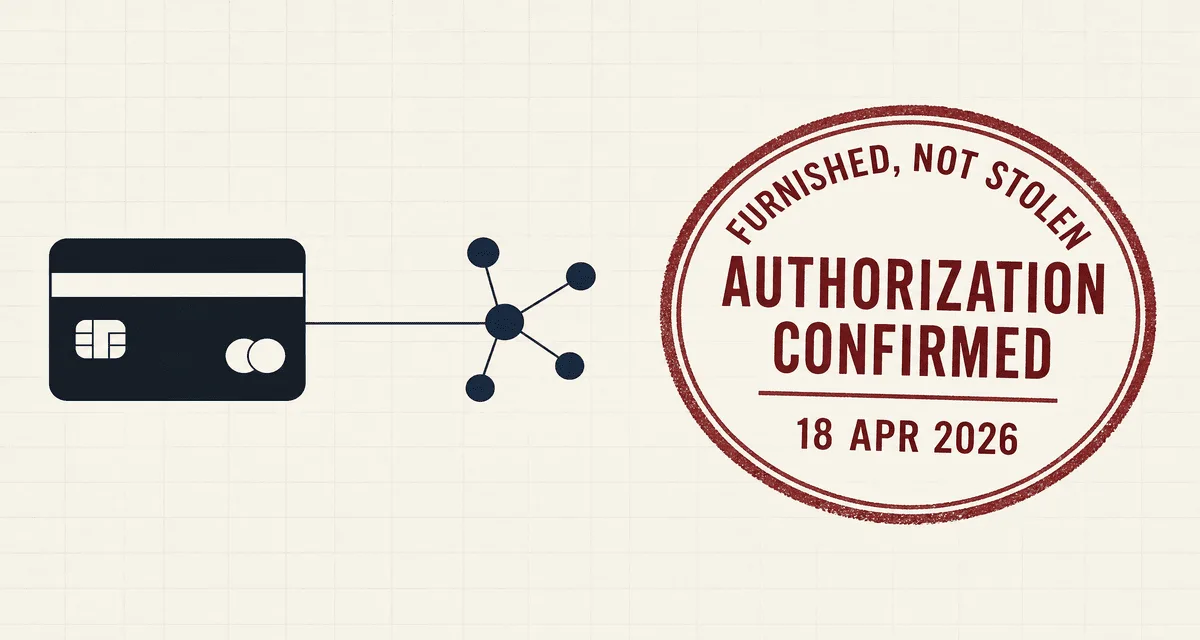
Visa updated its Core Rules on April 18, 2026, to formally cover what happens when an AI agent, not a person, completes a purchase. Law360 covered it in late May, in a piece by three payments lawyers with the dry headline "Visa's Agentic Payment Rules Expose Compliance Tensions." A separate legal analysis, part of a multi-part series on network rules and agentic commerce, made the sharper point: Visa didn't write new consumer protections. It routed agent-initiated purchases into the dispute machinery that already exists for every other card-not-present transaction.
That's the whole story, and it's a smaller story than the coverage around agentic commerce generally suggests. Nobody's arguing anymore about whether AI agents will shop for people — Visa's own numbers, cited in its October 2025 launch materials, put AI-driven traffic to U.S. retail sites up over 4,700% year over year. The argument that's actually still open is who eats it when the agent gets something wrong. Visa answered that question for its own rails in April. Most people using an agent checkout feature this year have no idea it happened.
- Visa's April 18, 2026 Core Rules update didn't add new consumer protections for agent purchases — it routed them into the existing card-not-present dispute process, the same one used for any web checkout.
- A validly signed agent token (AP2, Verifiable Intent, or TAP) defeats a fraud dispute automatically. None of the three verify whether the purchase itself was a good decision — only whether the agent was authorized to make it.
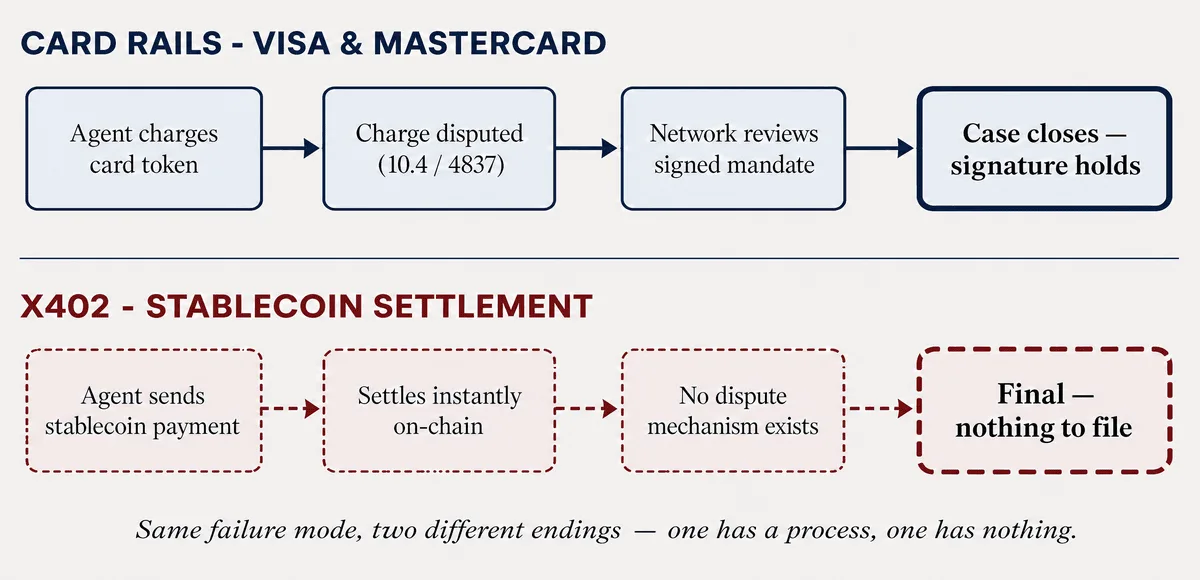
- On stablecoin rails like x402, there's no dispute mechanism to route into at all — settlement is final the moment it clears.
- This is a U.S. card-network analysis specifically. EU and UK consumers already have a standing right of withdrawal on most online purchases that changes the calculus (more on this below).
What Visa Actually Changed on April 18
Visa's agentic commerce framework — the enrollment and processing rules that sit alongside Visa Intelligent Commerce and the Trusted Agent Protocol it launched with Cloudflare in October 2025 — governs how an agentic payment provider gets onboarded, what it has to disclose about the agent's identity, and how the transaction gets authorized and cleared. What I couldn't find, and what the Law360 and Lexology-syndicated coverage both note without citing a specific rule number, is any new dispute category built for the specific case of "the agent did what it was told, and what it was told to do was a mistake."
So it falls back to the existing bucket: card-not-present, same as any web checkout. If you don't recognize a charge, the two live dispute paths are Visa dispute condition 10.4 (officially "Other Fraud – Card-Absent Environment") and, on the Mastercard side, reason code 4837 ("No Cardholder Authorization"). Both exist to answer one question — did the cardholder authorize this? — and both close the moment the payment processor can show a validly authenticated transaction went through. A signed agent token clears that bar without much trouble. The agent wasn't a fraudster. It had valid credentials and used them exactly as configured. That's not what either dispute code was built to catch.
The Protection Everyone Assumes Exists Is Written for a Different Kind of Mistake
This is where I'd push back on how most coverage frames it, including, honestly, an earlier draft of this piece. People reach for Regulation E — the federal rule that defines what counts as an "unauthorized" electronic transfer — as the backstop. And the actual text is worth reading closely, because it cuts against you more precisely than the summary version suggests. Under 12 CFR § 1005.2(m)(1), a transfer isn't "unauthorized" if it was initiated by someone you furnished the access device to, unless you'd already told your bank that person's authority was revoked. Hand your card token to an agent, and — in Reg E's own language — you furnished it.
Here's the catch nobody's flagging clearly enough: Reg E covers electronic fund transfers — debit rails, bank-linked payments, ACH. Most agent checkout flows right now are running on stored credit card tokens, which fall under Regulation Z and the Fair Credit Billing Act instead, not Reg E. Reg Z's unauthorized-use definition is worded differently and caps consumer liability at $50 regardless. So the Reg E citation that's been circulating in agentic-commerce commentary is doing work on debit-linked agent payments that it may not actually be doing on the credit rail most agents are using today. I'm not a lawyer, and I'd want a payments attorney to confirm how courts are actually treating "furnished the access device" when the furnishing was to a piece of software instead of a person — that's genuinely unresolved as far as I can find, not settled either way. But the framework difference is real, and I haven't seen it stated plainly anywhere else covering this.
What a Cryptographic Signature Actually Proves — and What It Doesn't
Two systems now exist specifically to fix the evidence problem in a dispute like this: Google's Agent Payments Protocol (AP2), which launched September 16, 2025 with more than sixty payment and technology partners, and Mastercard's Verifiable Intent, announced March 5, 2026 as a joint effort with Google, built on FIDO Alliance and W3C standards. Worth noting, because it's the kind of detail that gets flattened in secondary coverage: AP2 didn't launch with the two-mandate structure it has today. At launch it used three signed credentials — an Intent Mandate, a Cart Mandate, and a Payment Mandate. The current spec, published on the protocol's own site, has consolidated the first two into a single Checkout Mandate with open and closed states, paired with a Payment Mandate. Protocols move fast enough in 2026 that citing "the AP2 mandate structure" without a date is already slightly wrong by the time it's published.
What both AP2 and Verifiable Intent actually create is a tamper-resistant record of what the agent was told to do. That's genuinely useful in a dispute — it settles the "did the agent go rogue" question cleanly. What it doesn't settle is whether what the agent was told to do was a good idea.
"We'll have your back if something goes wrong" — a real commitment to fraud protection, not a promise that a poorly-executed-but-properly-authorized purchase gets reversed.
Pablo Fourez, Mastercard Chief Digital Officer, FinAi News, 2026
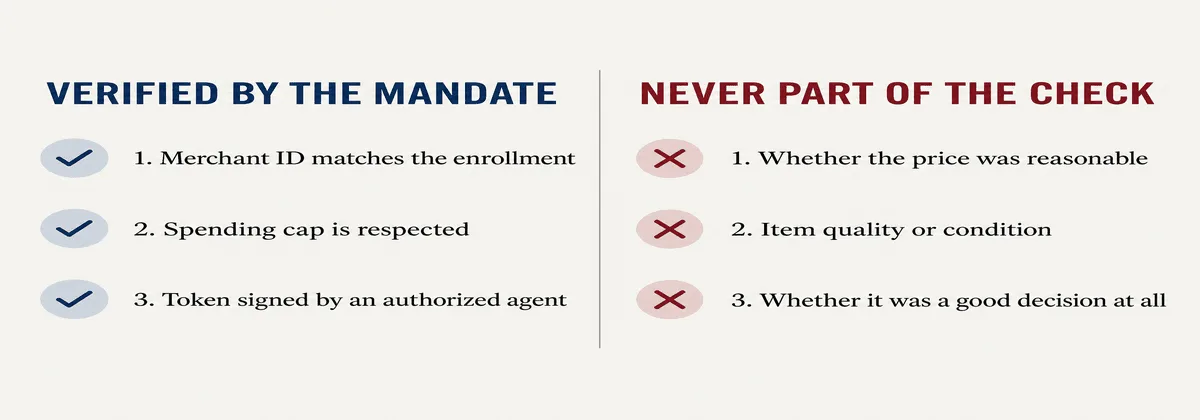
Tell an agent to buy a leather briefcase under $200, and a signed mandate clears the instant a $200 briefcase lands in the cart. Merchant ID checks out. Spending cap checks out. Whether $200 was a reasonable price for that particular briefcase was never part of what got verified — and if it shows up looking like it's worth about $40, the signature backing the purchase is still completely valid. That's not a bug in AP2 or Verifiable Intent. It's outside the scope of what either one was built to check.
| Payment rail | Governing framework | Dispute mechanism | If the agent gets it wrong |
|---|---|---|---|
| Debit / bank-linked | Reg E, 12 CFR § 1005.2(m)(1) | Bank error-resolution process | No help — furnishing the token to an agent isn't "unauthorized" |
| Credit card | Reg Z / Fair Credit Billing Act | Chargeback via issuer | Liability capped at $50 — different legal test than Reg E |
| Visa network (any card) | Dispute condition 10.4 | Card-not-present fraud dispute | Defeated automatically by a validly signed agent token |
| Mastercard network (any card) | Reason code 4837 | "No Cardholder Authorization" dispute | Same outcome — a valid signature ends the dispute |
| x402 / stablecoin settlement | None identified | No dispute mechanism exists | Nothing to file — settlement is final on submission |
Every row across the top four is a different legal test with the same ending: a validly authorized agent purchase has nowhere to go once it clears. The bottom row isn't a gap in the same table — it's a different table entirely, one with no dispute column at all.
The Objection This Piece Hasn't Answered Yet
There's an obvious objection to everything above, and I've been avoiding it: none of this is actually new. A human who buys the wrong size, the wrong color, or a briefcase they later decide wasn't worth $200 doesn't get a chargeback either. Buyer's remorse has never been a covered dispute reason on any card network, agent or no agent. If Visa's April update just extends that same, unremarkable rule to a new kind of shopper, it's not obvious this is a gap at all — it might just be the system doing what it's always done.
That argument has real force, and it's worth sitting with rather than waving off. But it misses two things.
First, a dispute code isn't the only kind of recourse, and treating it as the only one is where a chunk of the coverage on this topic — including earlier drafts of this piece — overstates the gap. Many premium cards carry purchase-protection or extended-warranty benefits that sit entirely outside Reg E, Reg Z, and the network fraud-dispute codes; ordinary merchant return policies still apply regardless of who clicked buy; and state-level unfair-and-deceptive-practices statutes exist independently of federal EFTA/TILA machinery. None of these are guaranteed to cover an agent's bad judgment call. But "there's no chargeback for this" and "there's no recourse for this" are two different claims, and it's easy to let them blur together.
Second — and this is the harder gap — the dispute-code question may be the wrong legal frame to start from. When you tell an agent "buy me a leather briefcase under $200," you haven't authorized a stranger to use your card; you've delegated a task to something acting as your agent in the ordinary legal sense of that word. Principal-agent liability is centuries-old contract and tort doctrine, and it's never had to answer what happens when the agent is software that can't be sued, fired, or held personally liable. That's a genuinely open question, tested in essentially no courts as of this writing, and it sits entirely outside the card-network rulebook this piece has spent the whole time inside.
One more scope limit worth being explicit about: every regulation this piece has walked through — Reg E, Reg Z, the FCBA — is U.S. law. It doesn't travel. Consumers in the EU and UK already have a standing right of withdrawal on most online purchases, agent-initiated or not, that would blunt a meaningful share of the "stuck with it" scenario regardless of what Visa or Mastercard do with their own dispute codes. A piece built entirely on U.S. card-network rules is describing one jurisdiction's version of this problem, not the global one — and the protocols in the timeline above are explicitly global.
Three Questions People Keep Asking Me About This
Does "agentic commerce" mean something different from "agentic AI" generally?
Yes, and it's worth being precise about it because the risk profile is different. Agentic AI is the broad category — any system that plans and acts toward a goal with minimal supervision. Agentic commerce is one narrow application of that: an agent specifically doing discovery, cart-building, and payment. The commerce piece is where real money moves without a confirmation click, which is why it's drawing separate rulemaking from card networks while the broader "agentic AI" conversation stays mostly in the realm of policy papers.
Is it actually safe to let an agent buy things for you right now?
For the fraud-prevention piece, yes — TAP, AP2, and Verifiable Intent all genuinely reduce the odds that a bad actor hijacks the flow. For the "will it buy the wrong thing and will you be stuck with it" piece, no meaningful new protection exists yet. Set a spending cap and treat it as a hard ceiling, not a formality — nothing in the current rule set treats it as one either.
If Visa already settled this, why does the coverage still call it an open question?
Because Visa only settled it for Visa's own rails, and even the legal analyses covering this are explicit that the harder gap sits outside card networks entirely — which is where this actually gets worse, not better.
If I authorize an AI agent to shop for me, can I get my money back if it makes a bad purchase?
Not through a fraud dispute — a validly authorized agent purchase defeats Visa dispute condition 10.4 and Mastercard's 4837 by design, the same way it would if you'd made the purchase yourself and simply regretted it. Outside the dispute system, ordinary recourse might still apply: a merchant's standard return policy, a card's purchase-protection benefit if it carries one, or state consumer-protection law. None of those are guaranteed, and none of them require proving the transaction was "unauthorized" — which is exactly why they're worth checking before assuming you're stuck.
What Visa's Update Doesn't Touch
Visa wrote this update for its own network. It says nothing about x402, the protocol Coinbase built specifically for agent-to-agent stablecoin payments — and this is the part I'd actually correct in how most coverage, including my own earlier framing, describes it. It isn't a case of "the rules aren't clear yet" for x402. Legal analysis of the protocol has been direct about this: x402 settles instantly on-chain and contains no mechanism for a reversal or chargeback at all — not a weaker one, not an unclear one, none. If an agent routes a purchase through a stablecoin rail instead of a card network, the entire dispute framework this piece just walked through — Reg E, Reg Z, dispute condition 10.4, reason code 4837, all of it — simply doesn't apply, because none of it was ever conditioned on the agent. It was conditioned on the card network.
So the practical version of all this: if your card runs on Visa or Mastercard rails, you're sitting on the same protections you had before an agent was involved, for better and worse. If a checkout flow settles through a stablecoin rail instead, ask before you connect it — because there may be nothing to ask for after the fact.